 Image 1 of 1
Shipping included in price.
Available in either 13” x 19” or 17” x 22” outer dimension, which includes the white border than can be trimmed by your framer or left as is (I kind of like it). =)
Custom sizes available upon request.
Behind the Image
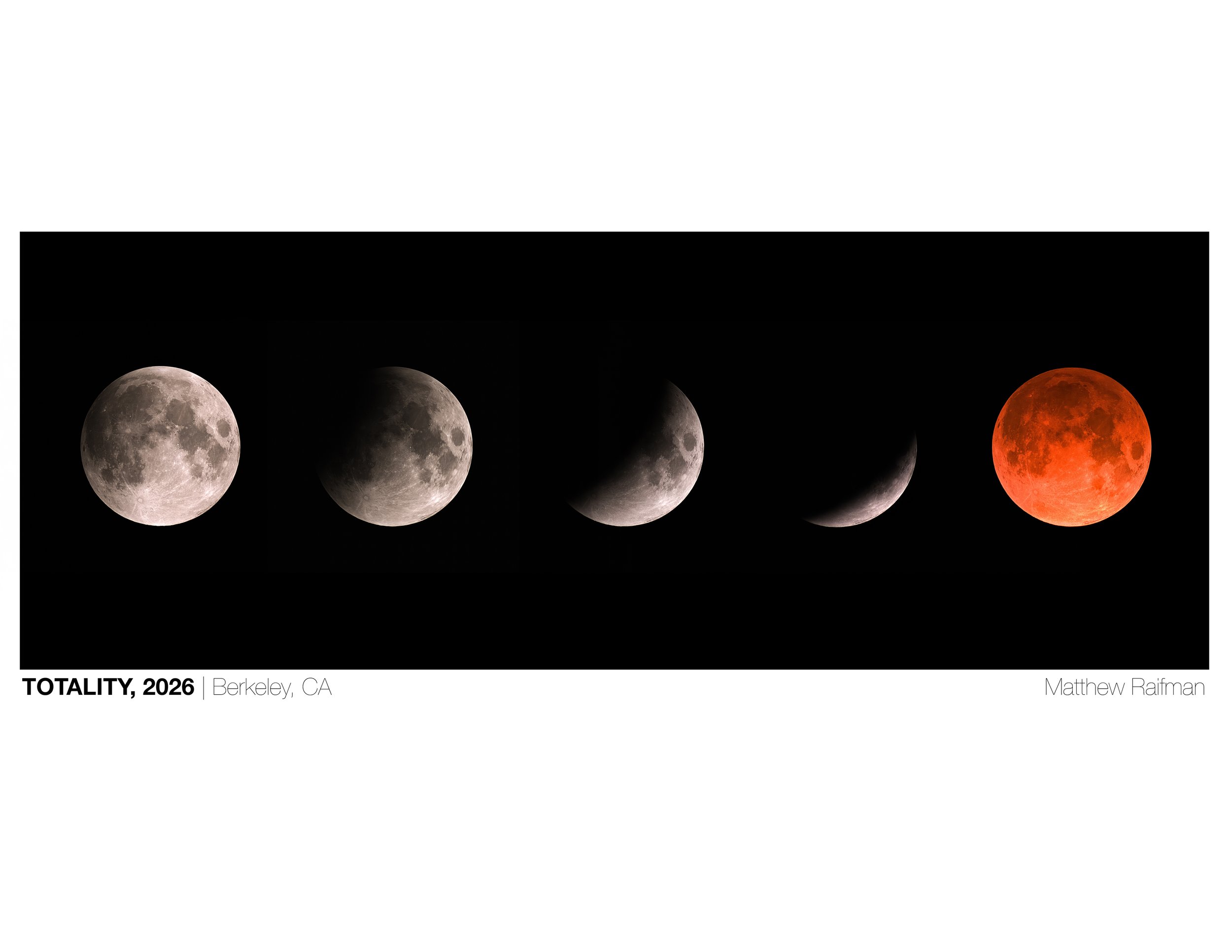
This composite image captures the progression of the Moon during the total lunar eclipse of March 2026 from my backyard in Berkeley, California. I had been dreaming of making a composite image like this for years. The unusual alignment of the full moon and the total lunar eclipse made it possible.
The eclipse started at 1:30am in California. Over the next two hours, the earth’s shadow crept across the face of the moon until, at 3:30am, the moon was entirely within the shadow of the earth. The extremely high dynamic range between the shadow part of the moon and the section still reflecting sunlight means that the moon appears to disappear over time. The moon did not disappear from view, however, but instead shifted to a deep copper-red color. Once the moon is entirely within the earth’s shadow, the effect (a product of Rayleigh Scattering) is fully visible. The atmosphere scatters blue wavelengths while bending red light through the atmosphere, such that the only light that reaches the moon is longer wavelength colors of red.
Making this image was fairly involved. I woke up at 1:30 in the morning at the beginning of the eclipse and began operating my smart telescope. I tracked the moon as it moved through the night sky, allowing for multiple images and for longer exposure times without blurring due to motion. As the moon moved into the earth’s shadow, the amount of light available to capture in the images dropped substantially and exposure times went from a small fraction of a second to well over a second. What you see in the image is not even five photos, but actually 250. I took 50 images of each stage of the eclipse and then stacked those images to provide enhanced detail and lower noise. I then merged all five phases together in a composite image in photoshop.
I’m thrilled by the final result and I hope that you are do.
Shipping included in price.
Available in either 13” x 19” or 17” x 22” outer dimension, which includes the white border than can be trimmed by your framer or left as is (I kind of like it). =)
Custom sizes available upon request.
Behind the Image
This composite image captures the progression of the Moon during the total lunar eclipse of March 2026 from my backyard in Berkeley, California. I had been dreaming of making a composite image like this for years. The unusual alignment of the full moon and the total lunar eclipse made it possible.
The eclipse started at 1:30am in California. Over the next two hours, the earth’s shadow crept across the face of the moon until, at 3:30am, the moon was entirely within the shadow of the earth. The extremely high dynamic range between the shadow part of the moon and the section still reflecting sunlight means that the moon appears to disappear over time. The moon did not disappear from view, however, but instead shifted to a deep copper-red color. Once the moon is entirely within the earth’s shadow, the effect (a product of Rayleigh Scattering) is fully visible. The atmosphere scatters blue wavelengths while bending red light through the atmosphere, such that the only light that reaches the moon is longer wavelength colors of red.
Making this image was fairly involved. I woke up at 1:30 in the morning at the beginning of the eclipse and began operating my smart telescope. I tracked the moon as it moved through the night sky, allowing for multiple images and for longer exposure times without blurring due to motion. As the moon moved into the earth’s shadow, the amount of light available to capture in the images dropped substantially and exposure times went from a small fraction of a second to well over a second. What you see in the image is not even five photos, but actually 250. I took 50 images of each stage of the eclipse and then stacked those images to provide enhanced detail and lower noise. I then merged all five phases together in a composite image in photoshop.
I’m thrilled by the final result and I hope that you are do.